
Awards & Honours
- 2017: B. C. Sanyal Award
- 2011: Rotary Club of Delhi – Lifetime Achievement Award for Vocational Excellence
- 2010: Sikh Art and Film Foundation, New York – Lifetime Achievement Award
- 2009: Chief Guest for conferring B.F.A. degrees, Delhi College of Art Convocation
- 2007: T. K. Padamini Award, Government of Kerala
- 2001: Advisory Committee Member, National Gallery of Modern Art (Delhi), Lalit Kala Akademi, and Sahitya Kala Parishad
- 1995–1998: Selection Committee Member, Republic Day Pageants, Ministry of Defence, Government of India
- 1995: Commissioned by Hiroshima Museum of Modern Art to execute a large work for its permanent collection on the 50th anniversary of the bombings
- 1991–1992: Purchase Committee Member, National Gallery of Modern Art, New Delhi
- 1990–2000: Collaborated with Godna artist Sat Narain Pandey and, for the first time in India, co-signed works with him
- 1990–2002: Jury Member, Republic Day Pageants, New Delhi; nominated Eminent Artist by Lalit Kala Akademi
- 1989: Jury Member, National Exhibition, New Delhi
- 1987: VI Triennale India – Gold Medal for Painting (International exhibition)
- 1986: Gold Medal at the 6th India Triennale, Lalit Kala Akademi
- 1985: All India Fine Arts Society (AIFACS) Award
- 1984: Research Grant from Lalit Kala Akademi for painting at Garhi Studio, New Delhi
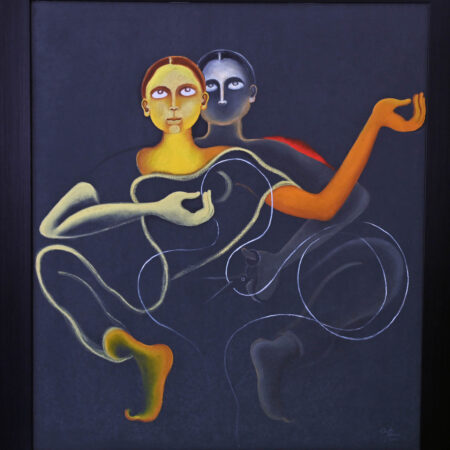
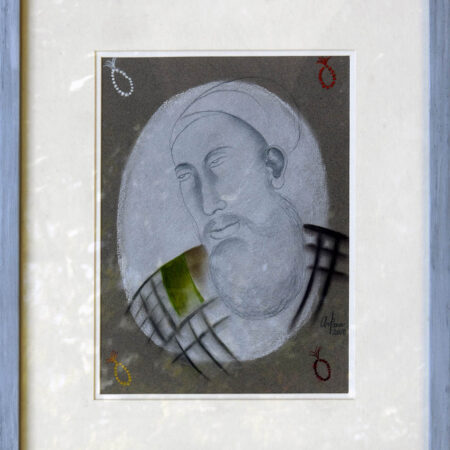
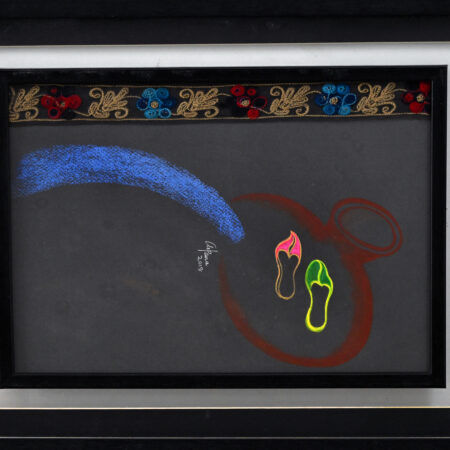
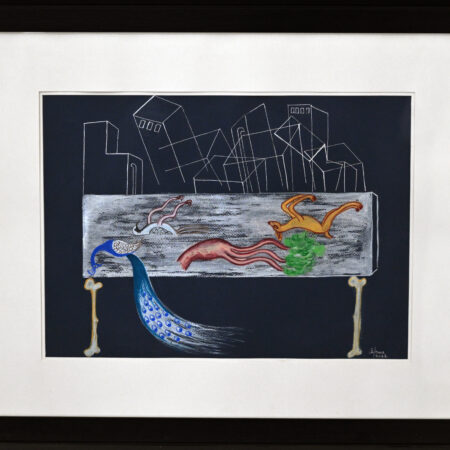
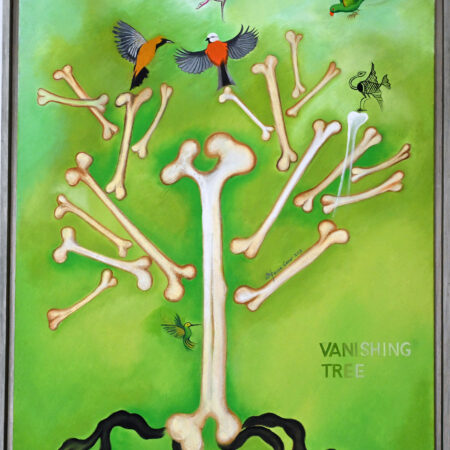
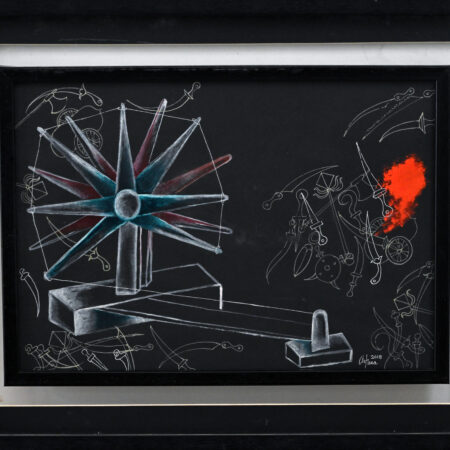
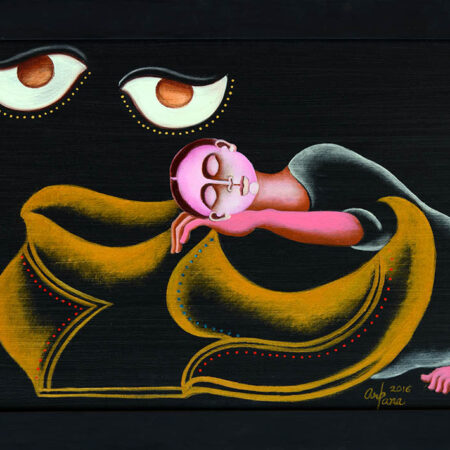
Arpana Caur (Born 4 September 1954 in New Delhi) is an Indian contemporary painter and graphic artist whose work is noted for its engagement with women’s lives, social injustice, and spiritual enquiry in modern India. A largely self-taught practitioner, she has developed a distinctive visual language that addresses themes such as life and death, violence, environmental degradation, and the condition of women in urban contexts, often using clothing as a motif that both affirms and questions conventional images of femininity.
Born into a Sikh family that migrated from West Punjab to India during the partition of 1947, Caur grew up in a culturally active household shaped by her mother, the Punjabi writer Ajeet Kaur. Exposed early to art, music, and literature, she learned the sitar, wrote poetry, and produced her first oil painting, Mother & Daughter, at the age of nine, drawing inspiration from Amrita Sher-Gil. Caur later obtained a Master of Arts degree in literature from the University of Delhi and subsequently trained in etching at Garhi Studios, New Delhi, completing this specialization in 1982.
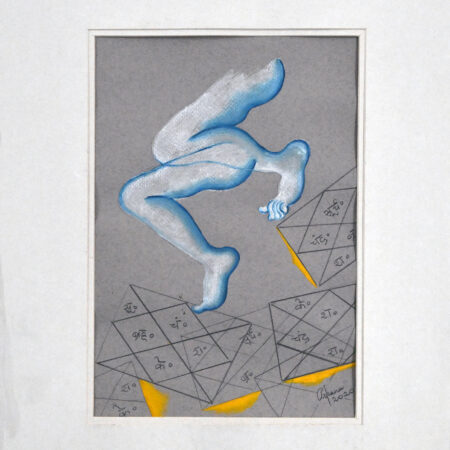
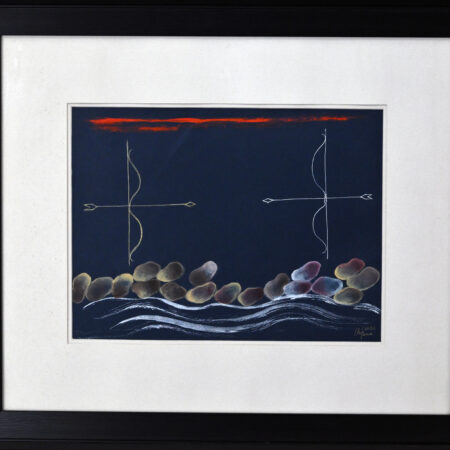
Caur’s practice is informed by a wide range of Indian artistic traditions, including Gond, Godna, Madhubani, miniature painting, and Pahari miniatures, which she fuses with contemporary concerns and narrative devices. Her oeuvre spans watercolour, gouache, sculpture, and mixed media, often layered with mythic references, folktale motifs, and symbolic elements such as the recurrent scissors form that earned her the sobriquet kainchi. Recurring thematic preoccupations with spirituality, time, nature, and mortality underpin her explorations of the human condition.
Exhibitions
- 2009: Mural on tiles for outer wall of SAARC Secretariat, Kathmandu
- 2007: Indigo Blue Gallery, Singapore
- 2005: Mahua Gallery, Bangalore
- 2004: Galerie Mueller & Plate, Munich
- 2003: Academy of Fine Arts and Literature, New Delhi; October Gallery, London
- 2002: Cymroza Gallery, Mumbai
- 2001: Academy of Fine Arts and Literature, New Delhi
- 1999: CIMA Gallery, Kolkata
- 1998: Fine Art Resources, Berlin; Foundation for Indian Artists Galerie, Amsterdam; Cymroza Gallery, Mumbai
- 1997: Arks Gallery, London
- 1996: Sakshi Gallery, Mumbai and Bangalore
- 1994: Cymroza Gallery, Mumbai
- 1993: Rabindra Bhawan Gallery, New Delhi
- 1991: Collins Gallery, Glasgow
- 1988: Art Heritage, New Delhi
- 1987: October Gallery, London
- 1985: Art Heritage, New Delhi; Cymroza Gallery, Mumbai
- 1984: Ethnographic Museum, Stockholm; National Museum, Copenhagen; Jehangir Gallery, Mumbai
- 1982: Chapter Gallery, Cardiff; Jehangir Gallery, Mumbai; October Gallery, London
- 1981: City Hall Gallery, Ottawa
- 1980: Jehangir Gallery, Mumbai
- 1979: Rabindra Bhawan Gallery, New Delhi; Gallery Arts 38, London
- 1975: Shridharani Gallery, New Delhi
Collections
- Victoria and Albert Museum, London
- Rockefeller Collection, New York
- Museum of Contemporary Art, Los Angeles
- Singapore Museum of Modern Art, Singapore
- National Gallery of Modern Art, New Delhi, Bangalore & Mumbai
- Government Museum and Art Gallery, Chandigarh
- Ethnographic Museum, Stockholm
- Kunst Museum, Düsseldorf
- Bradford Museum, Bradford
- Glenbarra Museum, Japan
- Deutsche Bank, Mumbai and Chandigarh
- Kapany Collection, San Francisco
- Asian Art Museum, San Francisco
- Jehangir Nicholson Art Foundation, Mumbai
- Birla Akademi Collection, Calcutta
- Peabody Essex Museum, Boston
- Reubens Museum, New York
- Venkatappa Museum (Roerich & Hebbar), Bangalore
- Bharat Bhawan, Bhopal
- Bengal Foundation, Dhaka
- J.K. Kejriwal Museum Collection, Bangalore;
- Dhaka Museum, Dhaka
In the 1990s, Caur undertook collaborative projects with folk artists from the Warli and Godna communities based in the Madhubani region of Bihar, positioning herself among the first contemporary Indian artists to co-sign works with rural artisans and to bring these idioms into a shared pictorial space. In 1995 she was commissioned by the Hiroshima Museum of Modern Art to create Tears from Hiroshima, a large mural marking the fiftieth anniversary of the atomic bombing; the work, which incorporated water-filled pots as a metaphor for collective mourning, was also shown at Documenta in Kassel.
Across her career, Caur has consistently resisted narrow categorization as a “feminist” artist, arguing that her concerns extend beyond gender to encompass issues such as communal violence, nuclear threat, and urban alienation. Nonetheless, her sustained focus on women’s bodies, clothing, labour, and suffering situates her practice at a crucial intersection of gendered experience, memory, and contemporary Indian visual culture.